

So, you've gone public
And you're finally ready to upgrade your home - send this to your favorite tech founder / Anthropic / OAI employee

I’ve found that, somewhat unsurprisingly, the vast majority of my firms residential design clients are founders and senior tech employees. I love this - I was a founder myself, and spent a decade building and investing in companies within the digital health industry (yes, a bleeding heart). Working with founders and tech people is in my DNA, and they tend to work quite a bit differently than the more traditional interior design client. I run Harding Home, where I’ve been working with clients big and small for around 8 years, and have found some interesting common themes with my Bay Area-based clients (who account for around 85% of my client base).
First - my clients are ruthlessly efficient, and expect the same of the people they work with. Construction, renovation, and design can traditionally be anything but - there are long timelines that can be pushed back without explanation, causing downstream effects for the entire project. As a graduate of the GSD* University (*get shit done) this has always been priority #1 for me: efficient timelines, and open, regular communication. Tech clients are used to making progress quickly, and have very little patience for progress that feels unnecessarily slow.
Second - my clients are super busy. This means that it falls on me to make their lives easier, not harder. Communication needs to happen in a timely manner, but grouped efficiently so I don’t need to bother a busy founder when they hardly have enough time to hydrate in a day. I find that where my clients elsewhere appreciate a one-off email here and there, my Bay Area-based clients want no more than weekly emails, grouped and organized by importance with clear action items and next steps. Luckily for this type A girl, this is right up my alley.
Third - it doesn’t matter how few hours exist in the day for my clients, most of them are intensely detail-oriented. They are used to building complex products taking into account edge case scenarios for a living, so nothing gets past them. My firms ethos is rooted in meticulousness and precision, and usually this creates a strong point bonding point. They are used to strong ownership, and appreciate a designer who owns the process end-to-end. I run the process, but nothing moves without your sign-off.
Fourth and finally, because of the way money flows in Silicon Valley, most of my clients are building almost entirely from scratch. When I worked with traditional executives in places like New England, I’d find that integrating existing treasures and pieces was a huge line item on the JD. In more traditional industries, salaries grow slowly over time: you’re likely to find someone who has gone through a starter home or two before landing on their forever space, at which point they’ve already collected a number of items they want to incorporate. I love this part of the process too and find it uniquely special, but in the Bay Area, my clients are much more likely to graduate from a one-bedroom with minimal belongings to a multi-million dollar home they now need to fill from scratch. This can actually make the process more difficult: creating a space that feels layered, unique, and timeless when you’re starting from scratch means being extremely deliberate in our selections, and I help my clients make their blank canvases feel like home.
So - understanding these common threads - what I recommend for those who have just purchased a new house and are trying to figure out how to make it home. These are some of the topics I like to discuss early with clients to help understand the “why” before getting into the “how”. Creating a beautiful space is equal parts taste, project management, and understanding my clients needs and wants intimately. It’s one of the things I love most about the work I do: the familiarity I build by understanding my clients loves, hates, and lifestyle.
Without further ado, since you’ve just exited, or otherwise landed the multi-million dollar home:
Assemble a portfolio: start looking for things you love, online, in real life, even in literature. The best homes are not inspired by the RH showroom, but by hotel lobbies, passages in the owners favorite book, a painting they saw on their last visit to London, the colors in a family friend’s garden, the pattern from a memory. A home that feels unique (and not for the sake of uniqueness! Which I whole heartedly do not believe in) is rooted in what you have loved across time, in your actual life. Put together a folder, a Pinterest board, a favorites folder in your photos, whatever works for you. Take some time with this step.
Determine the through lines that exist in your taste: no matter how seemingly disparate, there are always connective points amongst things you gravitate to. Ask yourself: are there common themes? Patterns? Lack of pattern? What materials or colors am I seeing often? What textures, or lack thereof? Do I like spaces that are monochromatic? That are colorful? Neutral? What kinds of neutrals? Warm, cool? Feel free to ask Claude / ChatGPT / Gemini to work through this with you if you’re a bit stuck - they aren’t designers, but they can help you understand your design language a little better.
Assess how you want to live: obvious, right? Maybe not so much! A spare room for a social butterfly who loves to entertain can be transformed into a game room, while the same room can be converted to a home theater for an introverted movie lover. How you live - whether you work at home, entertain, watch TV, have guests visit often, etc - impacts the space around you. So though it may feel obvious that a living room requires certain items (a coffee table, two chairs, a couch), this is one of my primary questions when working with clients. I’ve turned living rooms into game rooms, dining rooms into bedrooms, bedrooms into lounges. Ask yourself how you want to spend your time, and who you want to spend it with. Build from there.
Start with vintage: the general wisdom is that each room should contain around ¼ vintage or antique, and I think this is a great rule of thumb. Vintage items and antiques are what add soul and personality to a home. Whereas it’s virtually impossible to create a truly authentic space with 100% new items (even if you search far and wide), antiques are a great “shortcut” (though there are no true shortcuts in design…) to imbuing a space with soul. Some of my favorite sites for vintage and antiques are (from largest to most boutique) 1st Dibs, Chairish, Vinterior, Retrouvius, Monument, Oblist, Good Behavior Vintage, Delphie Studio.
Wait! It’s tempting to try and buy everything at once so you can finally feel at home, but resist the urge! Homes are supposed to be curated over time. Start with the essentials: a good, comfortable couch, a well-made bed frame, and expand from there. Especially if you’re going it alone, buying too many items at the outset is a really great way to regret the majority of your purchases while you’re still figuring out how you want to use the space.
Come find us at Harding Home when you're ready to make it feel like home - not just a place you sleep between board meetings. There are some real benefits to hiring someone who speaks the same language that you do: I already know how you operate before you tell me - weekly emails, clear next steps, no surprises.
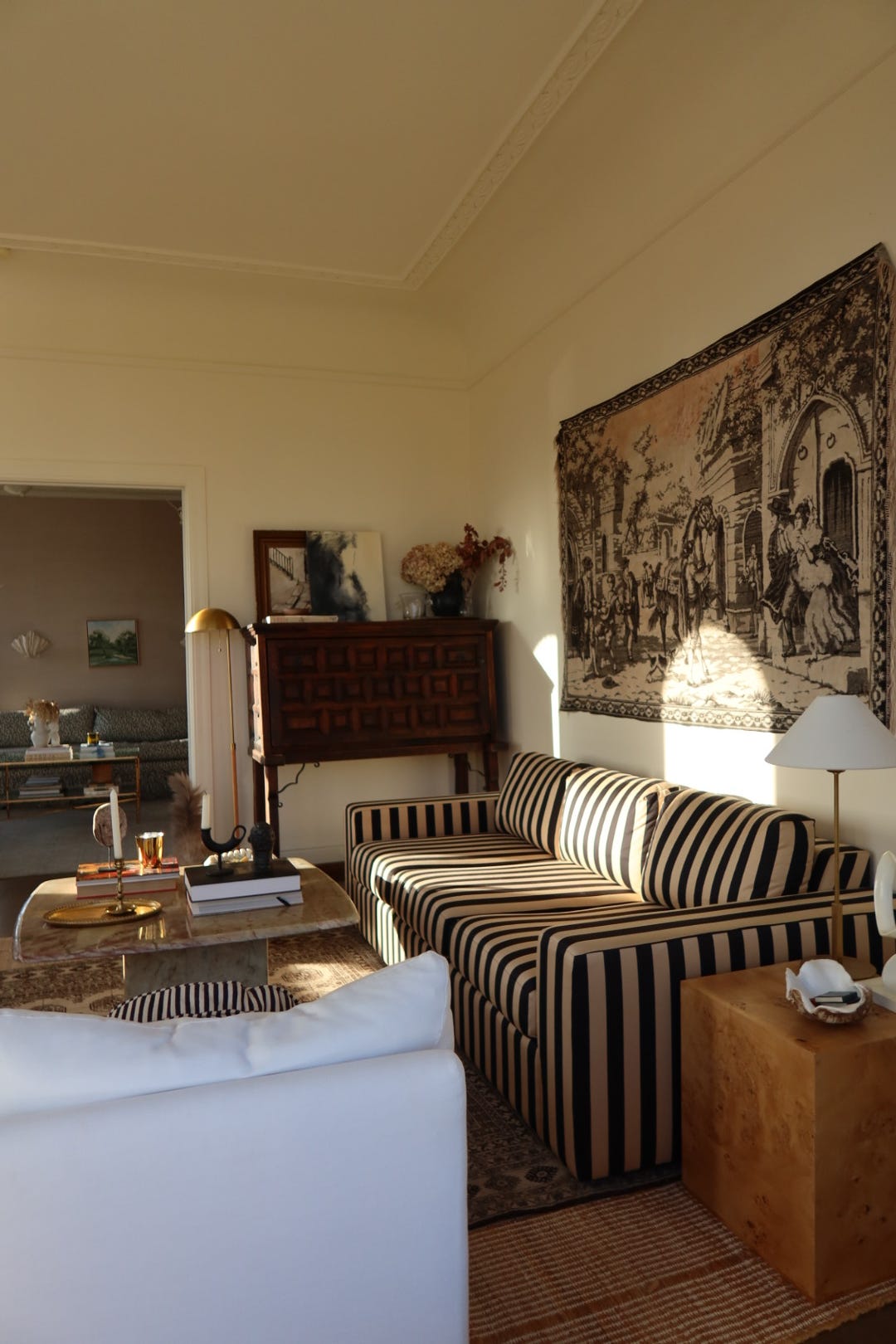
Do you like pretty spaces? So do we!